sábado, 11 de junho de 2011

Antec Sonata IV vs. Progress: Round Four

URL: http://www.anandtech.com/show/4440/antec-sonata-iv-the-steady-march-of-progress


Reviewing the Antec Sonata IV presented an interesting opportunity for me: while the other cases we've reviewed thus far have been experiences with new hardware, the Sonata IV is the next in a line of cases I'm particularly familiar with. I've built machines in every model from Antec's main Sonata range; my dad's computer is in an old Sonata, my ex-girlfriend's computer is in my old Sonata II, and a close friend's machine is purring along in a Sonata III. As a result, it's a chance to see how Antec's design has evolved over time. But it's more than that: the Sonata line has for a long time been a go-to for quiet computing with reasonable thermals. Has that changed with the Sonata IV?

quinta-feira, 9 de junho de 2011

Intel's Latest Processors Drop Sales of Discrete GPUs Dramatically - Analysts

URL: http://www.xbitlabs.com/news/graphics/display/20110609094145_Intel_s_Latest_Processors_Drop_Sales_of_Discrete_GPUs_Dramatically_Analysts.html


Sandy Bridge Brings Sales of Discrete GPUs Severely Down in China - Analysts

Samsung's 30nm DDR3 DRAM boosts speeds, cuts power consumption

URL: http://www.engadget.com/2011/06/09/samsungs-30nm-ddr3-dram-boosts-speeds-cuts-power-consumption/


Samsung RAM
Samsung has been taunting us with the promise of 30nm DRAM for quite sometime, and when the tiny chips went into mass production last year it was the world's servers that got first dibs. The average consumer stuck with that aging 40nm stuff -- blech. This summer though, you'll finally be able to snatch up some of Sammy's latest tech in the form of two and four GB DDR3 1600 sticks for both laptops and desktops. The company claims that its new RAM modules are up to two-thirds more energy efficient than more common 60nm chips and 20 percent faster that its own 40nm ones. Both solo and dual packs will be hitting retailers soon starting at "less than $30." Check out the PR after the break.

Continue reading Samsung's 30nm DDR3 DRAM boosts speeds, cuts power consumption

Samsung's 30nm DDR3 DRAM boosts speeds, cuts power consumption originally appeared on Engadget on Thu, 09 Jun 2011 12:00:00 EDT. Please see our terms for use of feeds.

Permalink   |   | Email this | Comments

be quiet! with new 80 Plus Gold and Platinum PSUs

URL: http://www.anandtech.com/show/4438/be-quiet-with-new-80plus-gold-and-platinum-psus


be quiet! with new 80Plus Gold and Platinum PSUs

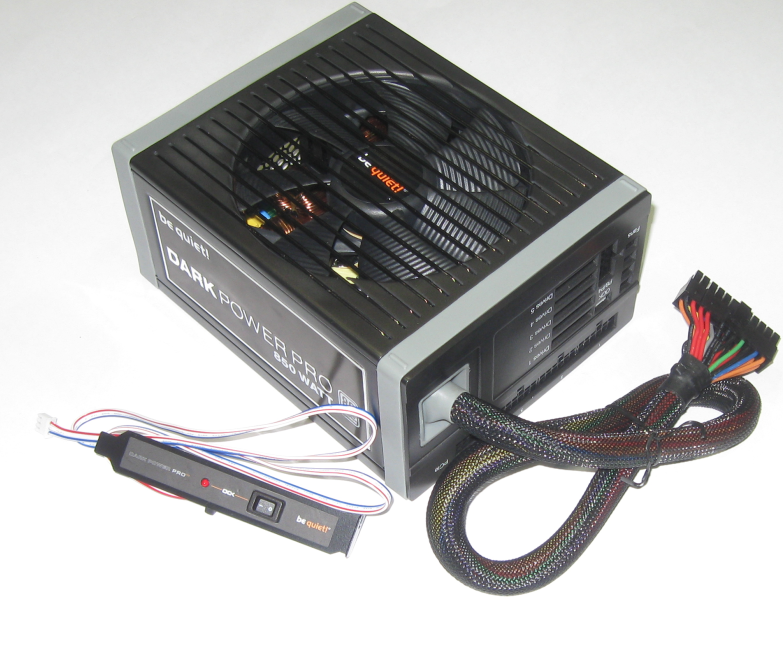
be quiet!, a German brand from Listan, showed some interesting new products at Computex. Late this year, be quiet! [Ed: silliest name award pending] will present one of the first 80 Plus Platinum PSUs. This 850W model has modular cables and offers a feature called "overclocking key" that allows the customer to choose between a +12V single rail or multi rail design. This PSU will be a part of the new Dark Power Pro P10 series. This series has 80 Plus Gold products starting from 550W.

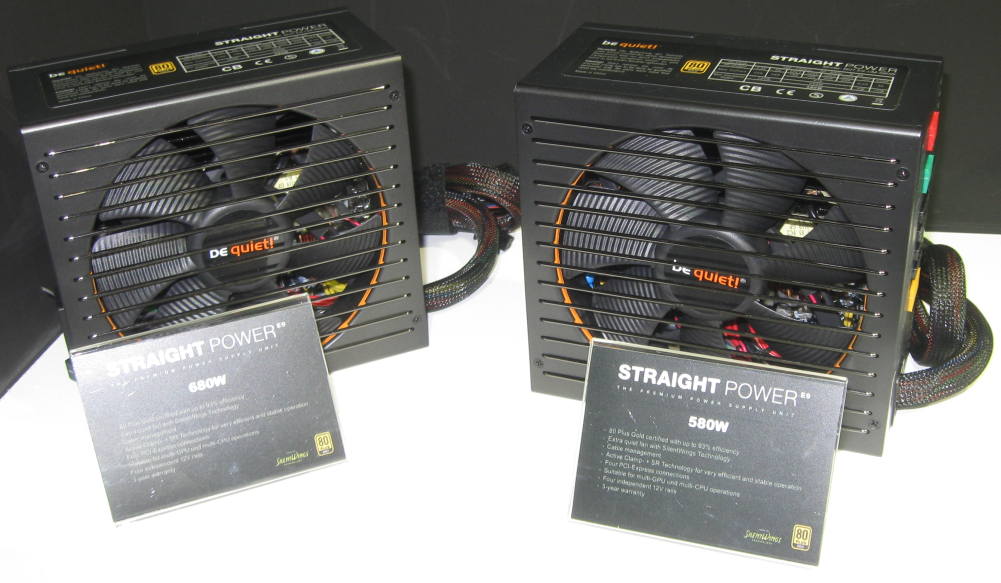
In addition to the P10 line, be quiet! will launch the Straight Power E9 series in September. These will also be modular PSUs, with 80 Plus Gold certification and prices similar to their predecessors. The most interesting feature could be their 135mm Silent Wings fan. Previously, they have had models with up to 120mm. be quiet! also presented a model called Efficient Power for the international market that will be less expensive than the E9 and P10 series.

Computex 2011: New All-In-One CPU Water-Cooling

URL: http://www.anandtech.com/show/4430/computex-2011-new-allinone-cpu-water-cooling


In the modern era, we’ve had systems from CoolIt, Corsair, Antec and others who are trying to bridge the barrier between high-end air-cooling and low-end water-cooling.  At Computex, it is clear to see that there are a few more options on the horizon for consumers.

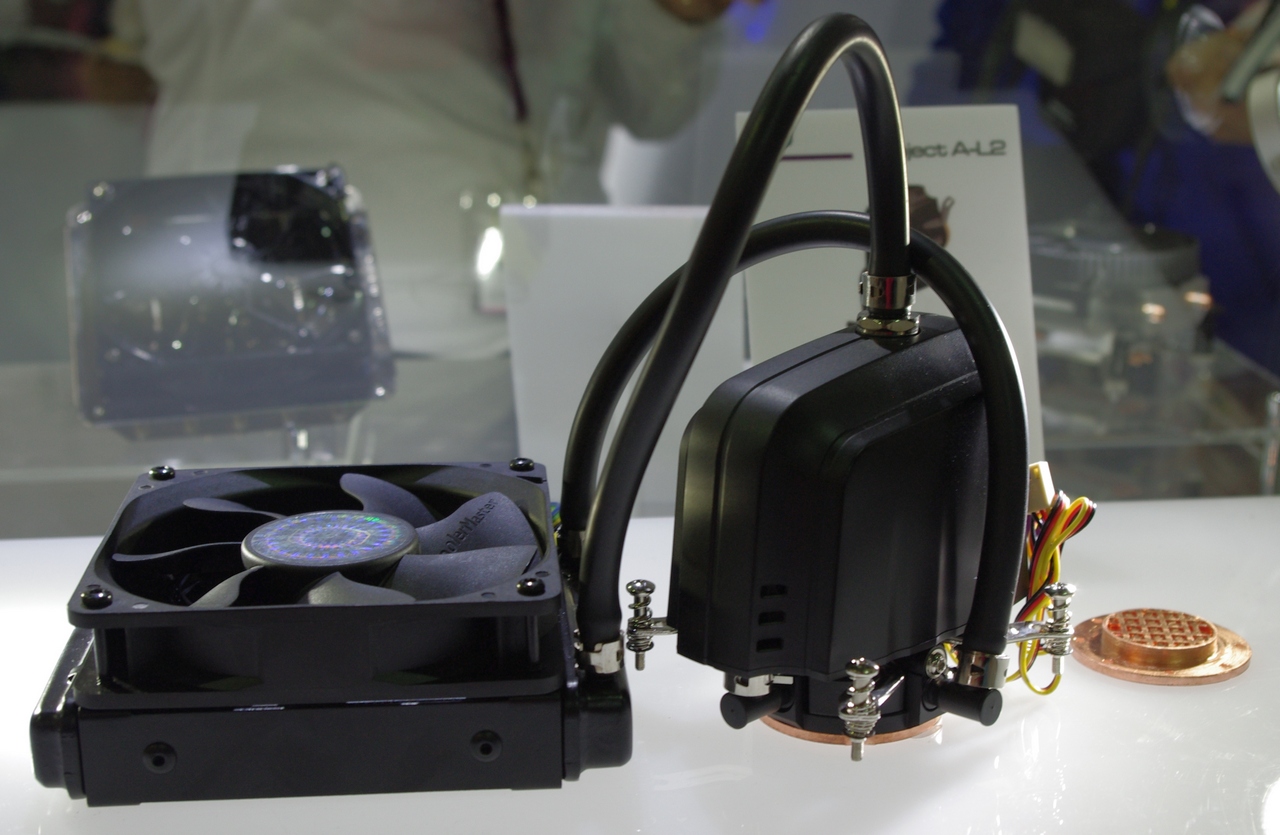
Cooler Master has produced all-in-one water-cooling systems in the past – I cite the Aquagate and Aquagate Mini for socket 462 systems many years ago.  The technology was young and prices were close to a DIY water kit.  However, with the Project A-L2, Cooler Master hopes to enter this segment again.

Still in the early design phase, Cooler Master wants to aim first at performance – their system is using a 450 litres/hour pump.  This has the effect of having a large, heavy base near the CPU, which is against the current trend of small CPU blocks.  The initial design is for a standard 120mm radiator and fan at $80-$100 projected price, though I’m told that a dual length radiator version may be in the design phase.

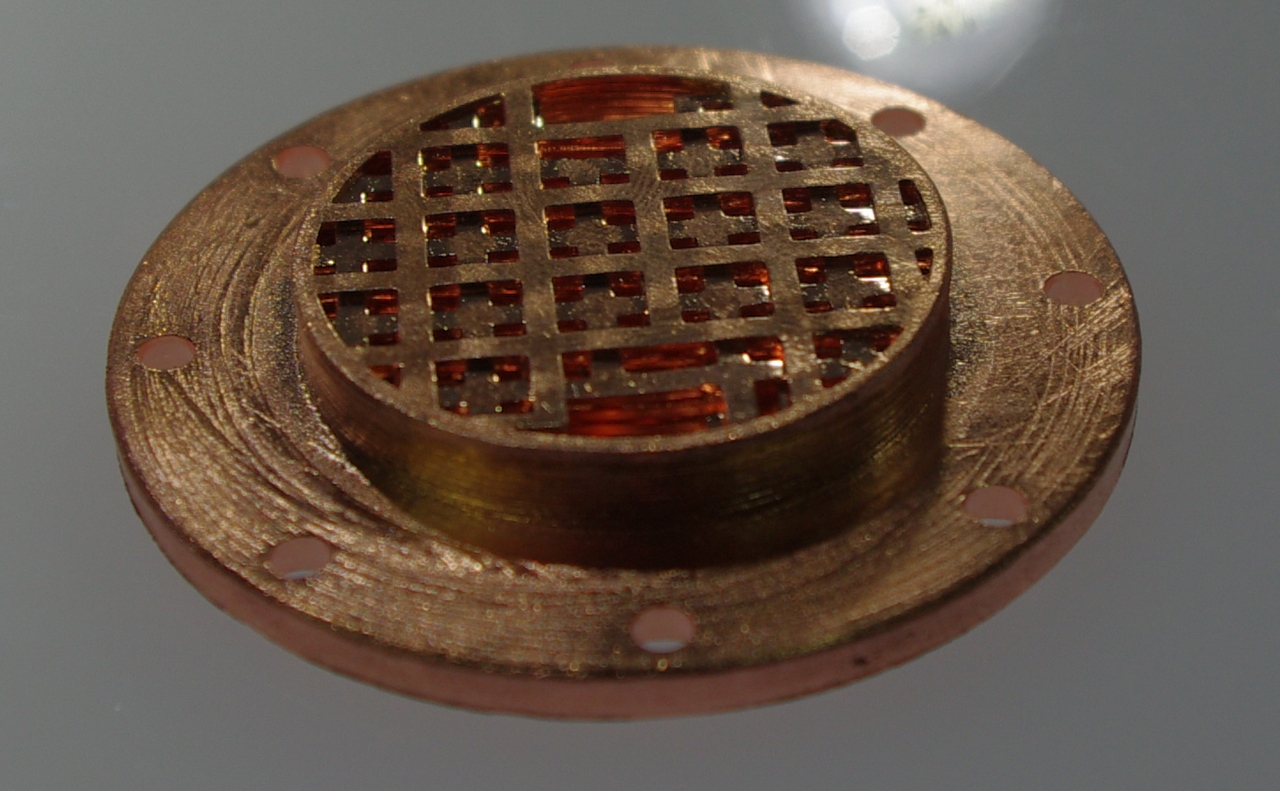
What was interesting though was that the heat transfer block was on display – Cooler Master openly had the internals of the water block out on show.  I was told that by using many different meshes bound together, that hopefully the maximum transfer of heat will occur.  As long as the heat transference from the copper base to the copper mesh is sufficient, it could work very effectively – however, we don't know of other mesh designs.

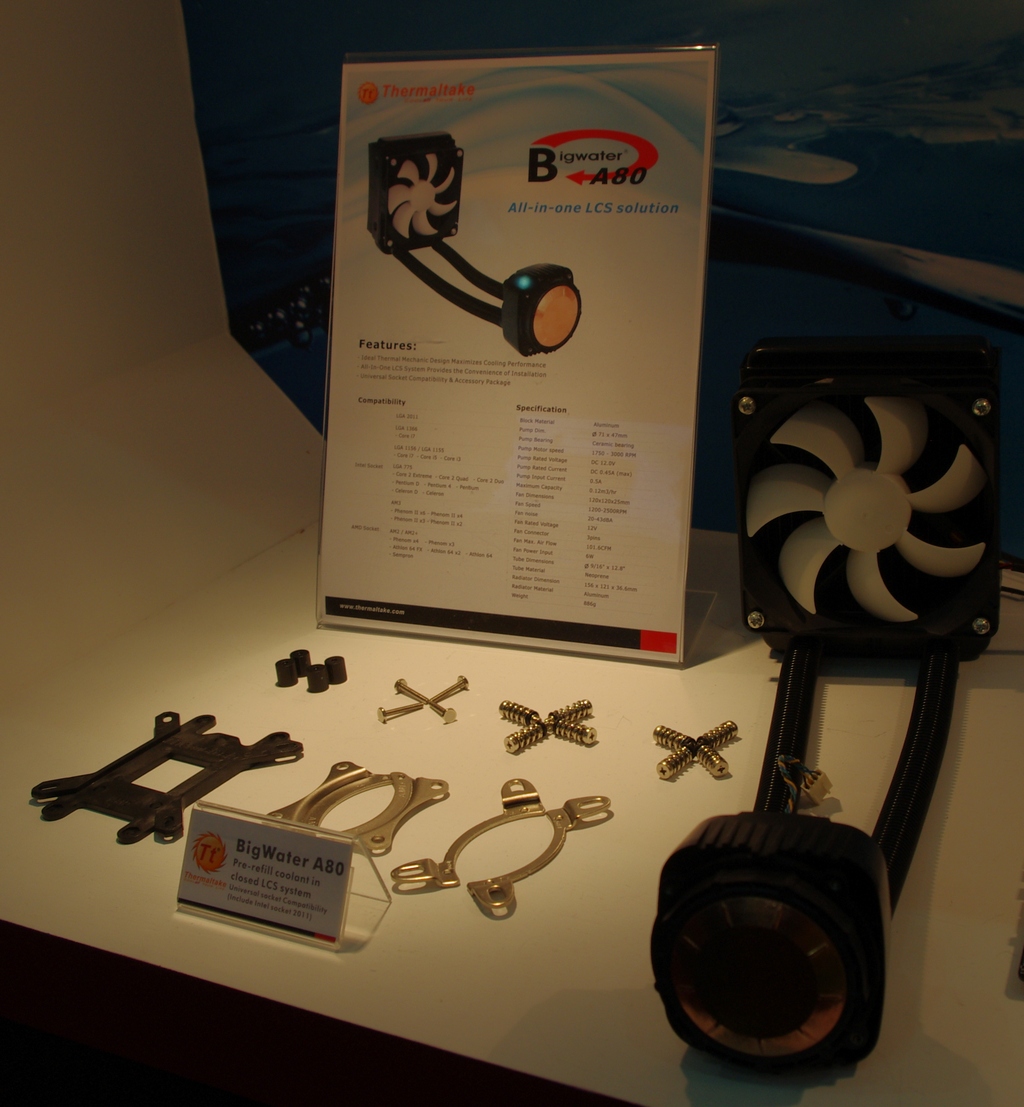
Thermaltake had two such units on display – the BigWater A80 and the dual 5.25” bay Bigwater 760 Plus.  The A80 unit is again very typical of what we currently see on the market in this segment – a CPU block with a pump leading out to a radiator.  The A80 unit is slightly different however, as the tubing to the radiator is a lot larger than what I’ve encountered previously.  The included fan is rated at 101CFM and the pump at 120 litres per hour.

The BigWater 760 Plus has design roots in traditional water-cooling, but utilizing the fact that many enthusiasts may have some unoccupied 5.25” bays.  The radiator is placed in this dual bay design with a fan and the pump, so we have a traditional waterblock and tubing.  This unit runs at 500 litres per hour, rated at 16 dBA, and designed in-house. There is no word on pricing or release dates yet.

In other news, during Computex Corsair released their H80 and H100 all-in-one CPU water-cooling solutions, to build on their H50, H60 and H70.  The H80 is an upgraded H70, with what looks like a beefier pump and fan control system in a double thickness 120mm radiator design.  The H100 is a dual length radiator design, with more advanced fan controls.

{gallery 1165}

Computex 2011: Silent and Single Slot GPUs

URL: http://www.anandtech.com/show/4429/computex-2011-silent-and-single-slot-gpus


In general, we see a trend in the market preference for quieter, smaller, cheaper, and more powerful GPUs.  In reality, we might see two or three of these features in a product, at the expense of the other(s).  I took the opportunity to visit as many vendors as my time allowed in Computex to find GPUs which could potentially fit into these categories.

On the NVIDIA side of things, Zotac where showing two silent models.  The first is actually a PCI card, rather than PCIe – a GT 430 with 512 MB DDR3 memory on a 128-bit bus, running at 700 MHz core speed and1600 MHz memory.  A purely silent card, it has a single slot design and supports DVI-I, HDMI, and VGA.  It’s interesting to see a PCI card on sale – they have their uses mainly in industrial applications, but due to the PCI specifications there’s a bandwidth limitation which may hinder any significantly faster GPU.

The Zotac 520 ZONE Edition, with 48 CUDA cores and 1 GB DDR3 memory on a 64-bit bus, runs at 810 MHz with 1600 MHz memory.  Again, this is a silent card, but a dual slot solution, supporting DVI-I and mini-HDMI.

Sparkle, apart from competing with Gigabyte and ASUS on SKU naming complexity, had three silent cards on display – a GTS 450 (SXS4501024DSSNMP), a GT 440 (SXT4401024S3LNMP) and a GT 520 (SXT5201024S3LNMP).  The GTS 450 version supports two DVI ports and a mini-HDMI, whereas the other two give the standard VGA, HDMI, and DVI connectors.  The GT 440 is a single slot solution, and all three have 1GB memory.

In terms of raw power in the veil of silence, we have to look at the AMD side of things and Powercolor, who have wrapped a HD6850 (yes, you read that right) in a passive heatsink using 5 heatpipes – this thing is massive:

The issue that probably bugs me the most about this card is I can see people using two in Crossfire.  In order to shift that much heat, the case will require sufficient cooling – i.e. fans, and thus defeat the point of silent running.

Powercolor also had two more sensible passive solutions on show: a HD6670 and HD6570.

In a similar vein, over at the AMD booth, they had selected passive cards from various manufacturers – an ASUS EAH6670, a Gigabyte HD6770 (GV-R677SL-1GD), a HIS 6570 Silence and an XFX HD5670 (HD-567X-ZNH).

{gallery 1164}

Even though there is a distinct trend to produce graphics cards with dual slot coolers, it does pique my interest when a manufacturer has a single slot solution to what is typically a dual slot answer.  This is often at the expense of length, fan noise, and cost of heatsink materials, but in terms of performance per unit volume, a good single slot GPU can sometimes be the answer.

So enter the Powercolor HD6850 Single Slot Edition.  Again, you read that right – a single slot 6850.  This card isn’t significantly longer than the standard 6850 from looks, put I’d wager that the fan must work hard to push air through when the card is working at a full load.

On the professional side of things, Sapphire had a FirePro V7900 on display as a single slot solution.  The V7900 is the 1280 streaming processor variant with 160 GB/s memory bandwidth, and differs from the commercial equivalent by utilizing features most people don’t need but professionals do.  My usual perception in terms of a environment using professional GPUs (i.e. clusters for simulation) is that more per machine is usually better, so I could see up to 7+ of these in one motherboard  – perhaps.

domingo, 5 de junho de 2011

Preços de PCs devem subir com alta em componentes

URL: http://redir.folha.com.br/redir/online/tec/rss091/*http://www1.folha.uol.com.br/mercado/925233-precos-de-pcs-devem-subir-com-alta-em-componentes.shtml


Computadores, notebooks e netbooks deverão ficar mais caros no Brasil ao longo dos próximos meses em virtude do repasse da alta de componentes eletrônicos produzidos na Ásia, informa reportagem de Camila Fusco para a Folha. A íntegra está disponível para assinantes do jornal e do UOL (empresa controlada pelo Grupo Folha, que edita a Folha). Segundo levantamento da consultoria IT Data antecipado à Folha, nos últimos 30 dias, as telas de cristal líquido aumentaram 10%, discos ópticos, para leitura de CDs e DVDs, subiram 20% e os discos rígidos, 30%. Leia mais (04/06/2011 - 07h00)